DEM - Wearing
particle wear on an inclined plate
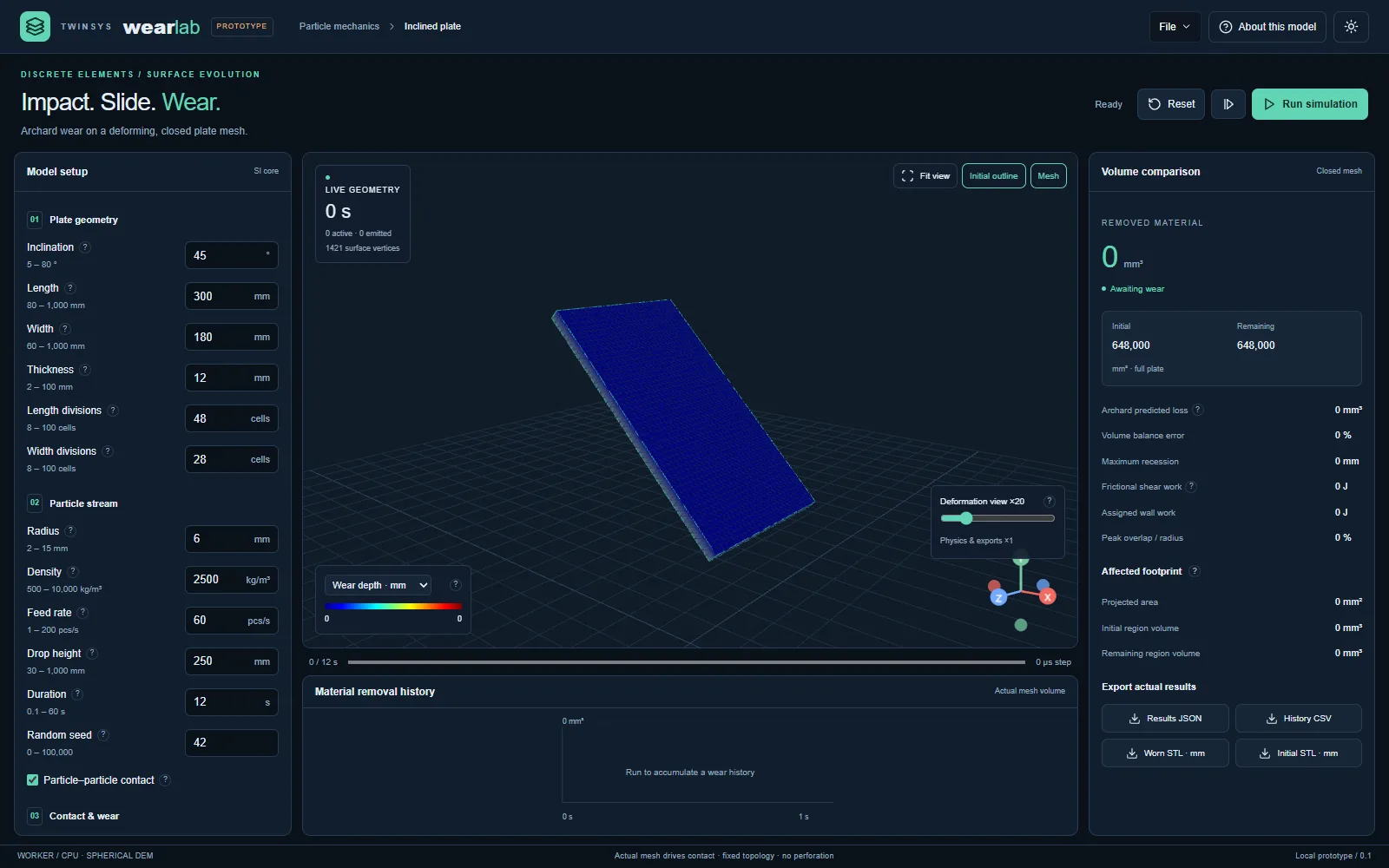
Simulate particles sliding down an inclined plate and wearing it by Archard's law, with the worn surface fed back into contact.
Product pages are in English.
Highlights
- Inclination, plate size, particle size, density, feed rate and friction set per run
- Worn volume from wall shear work moves the contacted surface inward along its normal
- Removed volume checked against the wear law throughout the run
- Plate coloured by wear depth or wall work, with a removal-history chart
- Results JSON, history CSV and the worn plate as STL; save inputs on your computer or cloud
A question it answers
Where on an inclined liner does a stream of sliding particles wear first, and how does the wear footprint move with inclination, friction or feed rate?What you put in
Plate inclination (5 to 80 degrees from horizontal), length, width and thickness, and mesh divisions along and across the slope; particle radius (2 to 15 mm), density, feed rate, drop height, duration and random seed; particle-to-particle contact on or off; friction coefficient, restitution, normal contact stiffness, wear coefficient C (worn volume per joule of wall work) and wall work share. Inputs lock once a run starts; Reset to edit them.
What you get
Live 3D view of the particles and the plate coloured by wear depth or nodal wall work, with the initial outline and a visual-only depth magnifier; removed material from the closed-mesh volume difference beside the Archard-predicted loss and the volume-balance error; maximum recession; frictional shear work and assigned wall work; peak overlap relative to the radius; the affected footprint area with its initial and remaining volume; a removal-history chart; and downloads of a results JSON, a history CSV, and the worn and initial plate as STL in millimetres.
More in this family
Heat Sink
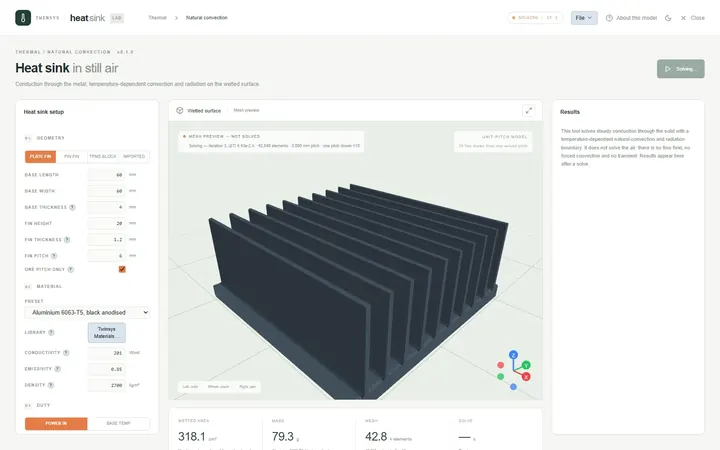
PremiumPredict how much heat a heat sink sheds in still air by natural convection and radiation, and find the fin pitch that works best.
Ice Cream Line
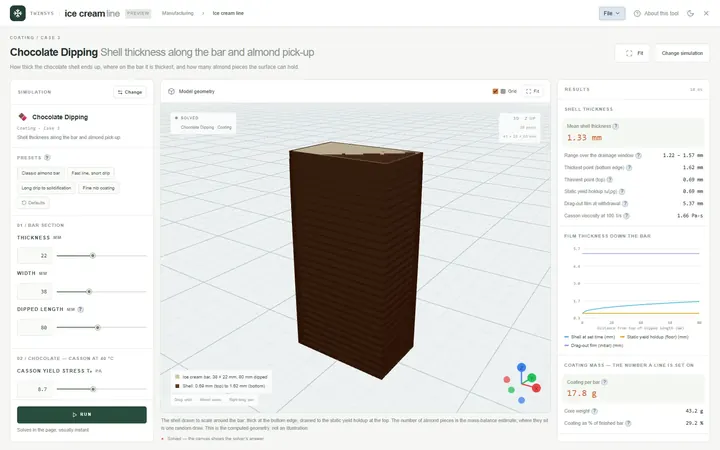
PremiumModel a frozen-dessert line case by case: freezing time, hardening tunnel, chocolate dipping, extrusion, coating, toppings, cornet line.
DEM
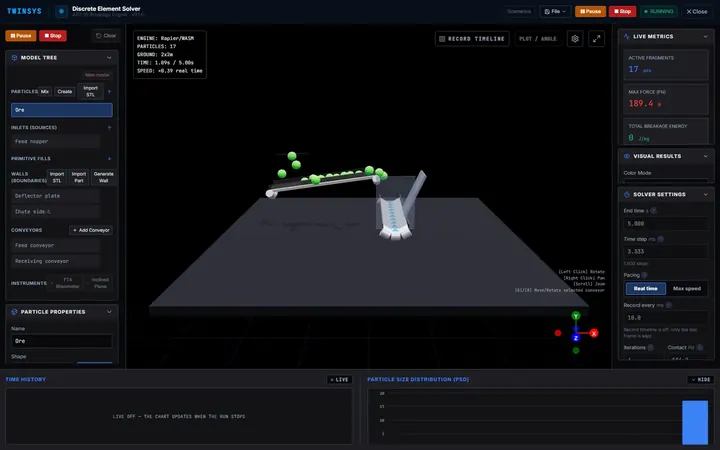
PremiumSimulate bulk material in transfer chutes, conveyors and screens with the discrete element method, and calibrate it with built-in tests.
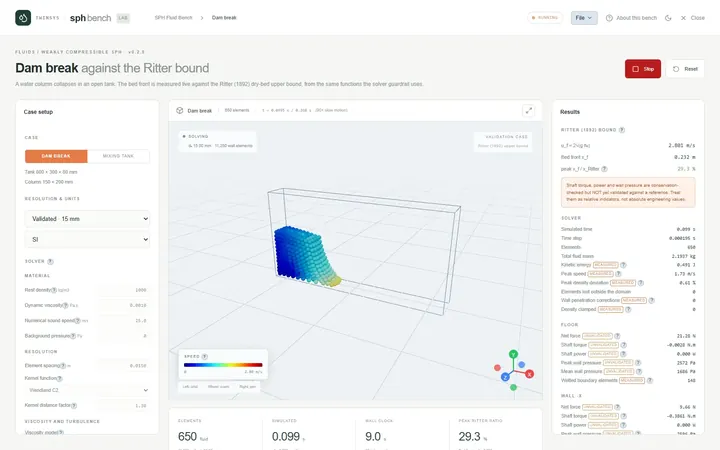
SPH Fluid Bench
PremiumWatch a weakly-compressible SPH fluid solver run a dam break checked against Ritter's solution, and a stirred mixing tank.